
Food-Contact HTV Silicone Rubber: Supplier Vetting Checklist
Food-Contact HTV Silicone Rubber: Supplier Vetting Checklist
Food-contact grade HTV silicone rubber is a solid, high-temperature-vulcanizing (HTV) silicone compound formulated for molded parts that repeatedly contact food — baking molds, kitchenware, food-processing gaskets and appliance seals. Vetting a supplier of this material is a documentation exercise before it is a price exercise. The buyer needs to see third-party test documentation issued against FDA 21 CFR 177.2600 for the specific grade, confirm that the base compound is delivered without pigment or curing agent already blended in, and receive a written processing window — commonly a DBPMH dosage of around 1.5% with a molding cure of approximately 180 °C for 5 minutes — that fits the buyer's own press and mold.
This checklist is written for procurement managers, product engineers and brand owners who are evaluating a food-contact HTV silicone rubber supplier and need to separate a genuinely qualified compound from a general-purpose grade carrying a food-safe label. It covers seven verification steps, two reference tables, and the document set that should be in hand before a purchase order is issued.
The checklist in brief:
- Third-party food-contact test documentation tied to the exact grade, not to the supplier's general capability.
- A written statement that the base compound is supplied without pigment and without curing agent.
- A processing window stating catalyst dosage (DBPMH 1.5%) and cure conditions (180 °C for 5 minutes).
- Mechanical benchmark values — for example 50 ± 3 Shore A, tensile strength ≥ 7.0 MPa, elongation ≥ 700% and tear strength ≥ 18 kN/m on a reference grade such as YKS-8850.
- Batch-level inspection records plus a batch COA issued before shipment.
- Commercial terms that match your program: MOQ, lead time and capacity.
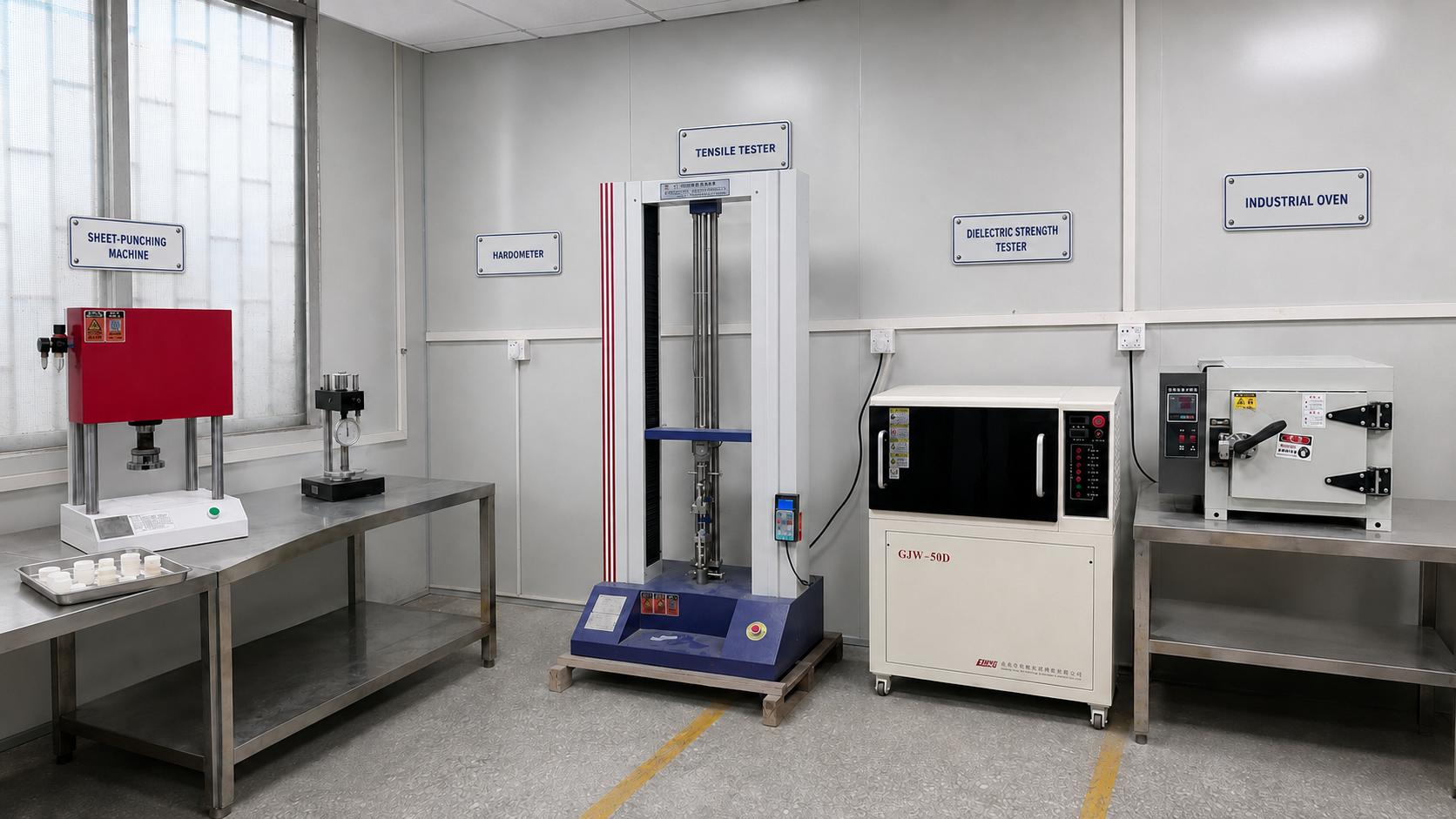
Batch testing capability is itself a vetting question: ask which properties are measured on every lot, not only on the development sample.
Why Food-Contact HTV Sourcing Fails Verification
Four failure modes account for most food-contact silicone problems, and none of them are visible in a supplier's opening quotation.
1. Material compliance is confused with finished-article compliance. A compliant compound does not automatically produce a compliant molded article. Cure conditions, pigment, release agents, post-curing and molding-environment hygiene all sit between the compound and the finished part. A buyer who vets only the raw material, and not the processing chain, can still end up with a part that fails migration or sensory evaluation.
2. The compound arrives fully pre-compounded. When pigment and curing agent are already blended in by the supplier, the buyer loses control of cure speed, color consistency and — more importantly — the identity and dosage of the additives that end up in a food-contact part. A base compound supplied without pigment or curing agent keeps that decision with the buyer and makes the additive declaration auditable.
3. Processing parameters are assumed rather than documented. A grade that vulcanizes cleanly at 180 °C for 5 minutes under one supplier's conditions may behave differently in another press with different thermal mass, mold geometry or cycle time. If the curing-agent dosage is not fixed — for example DBPMH at 1.5% — the buyer cannot reproduce the mechanical properties the supplier reported.
4. Batch variation stays invisible until molding. Hardness drift, a drop in tear strength or a change in cure rate usually surfaces as rejects rather than as an incoming-inspection failure, especially when incoming checks are limited to visual appearance.
Decision rule: if a supplier cannot produce a grade-specific document set — TDS, SDS, Typical COA, batch COA and applicable third-party test reports — the discussion should stop at sample stage. Verbal assurance of food-contact suitability is not a substitute for documentation.
Market Background: What the Numbers Say About Supply
The global silicone rubber market was valued at USD 5.7 billion in 2025, with HTV silicone rubber holding a 45.2% share, according to Vertex AI Search / Cloud Google market data. Published totals differ considerably between research bodies because they count different product scopes, so any single market-size figure should be treated as directional rather than precise.
Inside the HTV segment, solid HTV silicone rubber accounted for 58.3% of the market in 2025 (Dataintelo), which reflects how much of the industry still relies on compression and injection molding of solid compound rather than liquid silicone rubber. Global silicone trade reached USD 8.51 billion in 2024, with China the second-largest exporter at USD 1.53 billion (OEC) — a reminder that sourcing food-contact compound from Asian manufacturers is a mainstream supply decision, not an exception.
Regulated segments keep expanding. The global medical grade silicone market was estimated at USD 1.77 billion in 2025, growing at a CAGR of 6.41% (Mordor Intelligence). Food-contact grades follow a similar logic: availability is not the constraint. Verified documentation is.
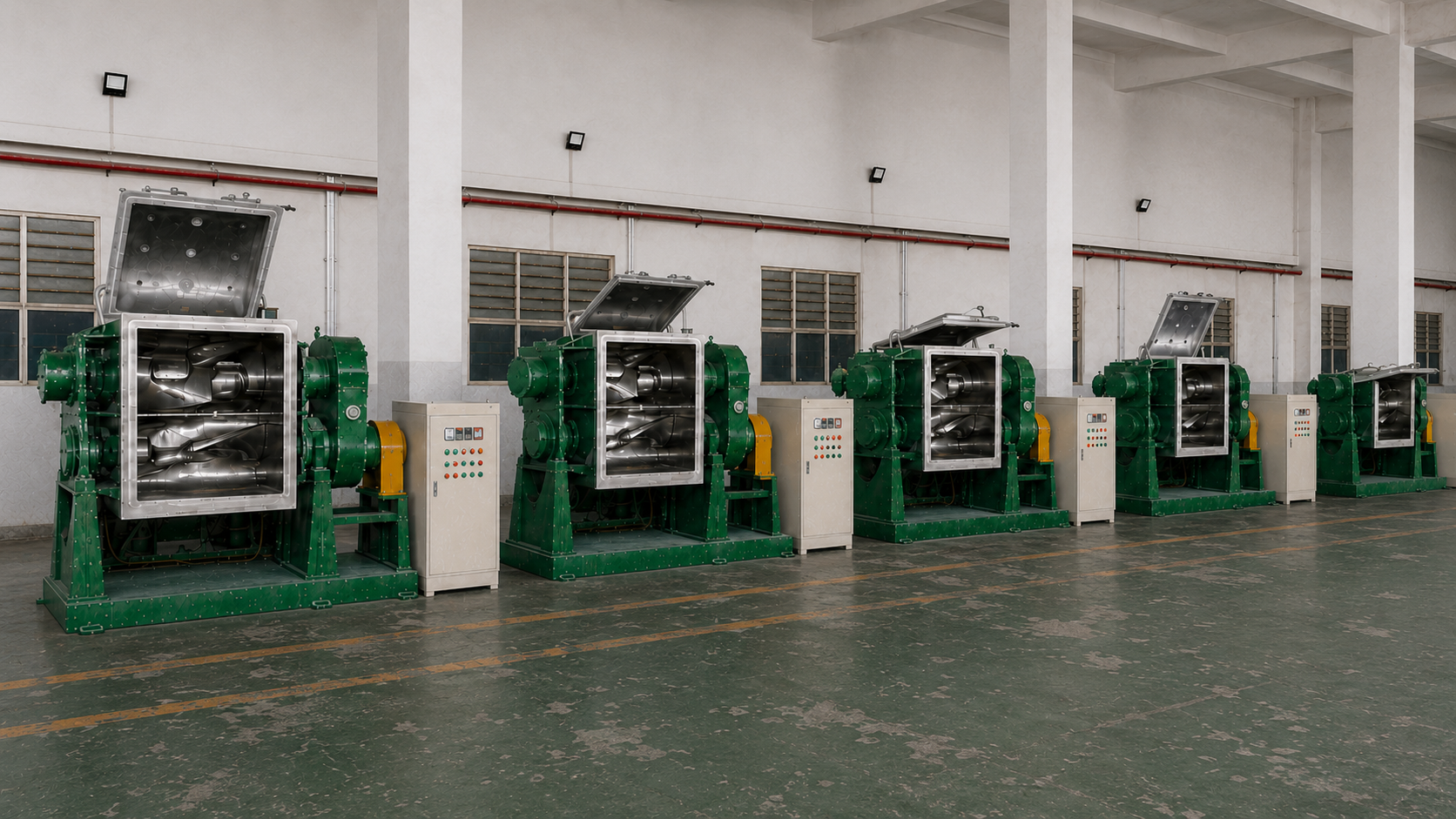
Compounding consistency starts at the kneader: buyers should ask how formulations are reproduced between production runs.
The Evidence Package a Food-Contact HTV Supplier Should Provide
A complete package for a food-contact grade HTV silicone rubber compound contains four groups of material: product documents, compliance documents, formulation and processing statements, and commercial terms.
Product documents. The technical data sheet (TDS) defines nominal hardness, density, tensile strength, elongation, tear strength and recommended cure conditions. The safety data sheet (SDS) covers handling, storage and hazard information. A Typical COA shows representative values for the grade, while a batch COA records the measured values of the specific lot being shipped. Yakows Technology (Dongguan) Co., Ltd., a Dongguan-based manufacturer of HTV/HCR silicone rubber compounds established in 2020, states that grade-specific documents — TDS, SDS, Typical COA, batch COA and applicable third-party test reports — can be provided to support customer evaluation and product approval.
Compliance documents. Applicable product grades are supported by FDA food-contact compliance documentation, LFGB test reports and REACH compliance documentation according to the intended application and destination market. FDA 21 CFR 177.2600 evidence and EU-market evidence are separate streams and should be requested separately rather than treated as one generic “food grade” certificate.
Management-system evidence. A quality management certificate tells the buyer whether inspection and batch release follow a standardized process. Yakows Technology (Dongguan) Co., Ltd. holds ISO 9001 Quality Management System certification (certificate 75725Q0464R0S) issued by ZhongPin Testing & Certification Center (Guangzhou) Co., Ltd., valid from 28 November 2025 to 27 November 2028, certified to GB/T19001-2016/ISO9001:2015, with a scope covering the sales of general machineries and parts, molds, and rubber compound and raw materials.
Formulation and processing statement. The supplier should confirm in writing whether the base compound is supplied without pigment or curing agent, and state the recommended catalyst dosage and cure conditions for that specific delivery form.
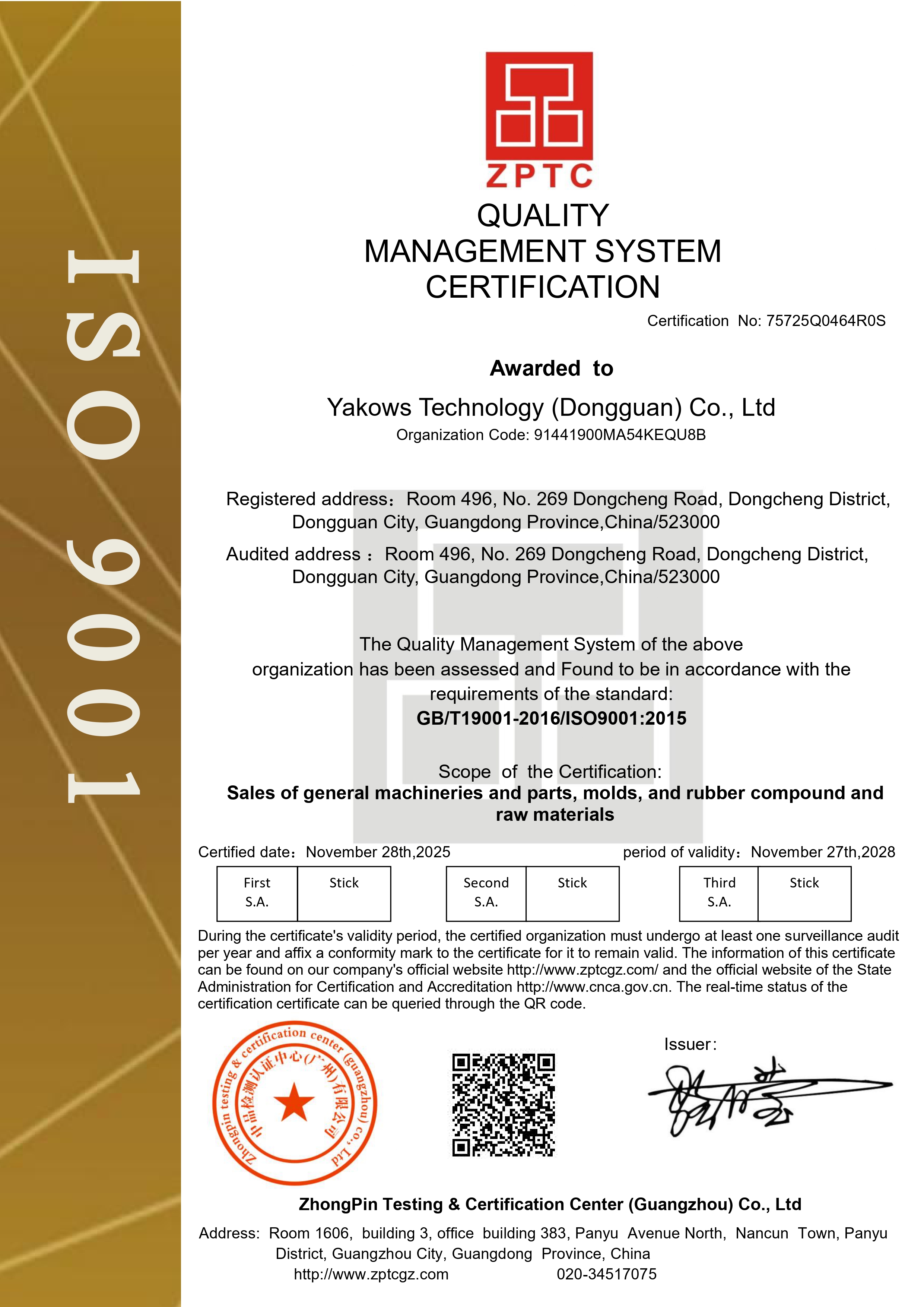
Quality-system evidence: certificate number, issuing body, validity period and scope should all be checked, not only the certificate headline.
Step-by-Step: Vetting a Food-Contact HTV Silicone Rubber Supplier
Step 1 — Define the regulatory scope of the finished article
Before contacting suppliers, write down which market the finished part will be sold into and whether it is a repeated-use food-contact article. FDA 21 CFR 177.2600 covers rubber articles intended for repeated use in contact with food; the European route relies on LFGB test reports and REACH compliance documentation. A supplier can only respond precisely if the scope is stated up front, and the buyer avoids the common error of accepting an electrical-insulation or general-purpose document set as proof of food-contact suitability.
Step 2 — Request third-party test documentation for FDA 21 CFR 177.2600
Ask for the report itself, not a certificate of conformity. Four details matter: the report identifies the grade or compound reference; it states the test conditions; it names the issuing laboratory; and it is current relative to the formulation you will receive. A report issued for an earlier or different formulation does not transfer to the lot you buy. If the destination market is the EU, request LFGB test reports in parallel together with REACH compliance documentation, and keep the two evidence sets separate in your approval file.
Step 3 — Confirm the base compound is supplied without pigment or curing agent
This is the most useful single question in the checklist, because it determines who controls the cure system. A base compound supplied without pigment or curing agent lets the buyer set color, catalyst addition level and cure speed in-house, and it makes every additive in the finished part declarable. If the supplier instead ships fully pre-compounded material, require a written additive declaration covering pigment type and dosage, curing agent type and dosage, and any processing aids — then re-validate the processing window against your own press before approving the grade.
Step 4 — Verify the processing parameters: DBPMH dosage and molding cure
Request the processing window in writing. A DBPMH dosage of approximately 1.5% and a molding cure of about 180 °C for 5 minutes are typical reference conditions for a food-contact HTV grade, and they should be stated as a defined starting point rather than left to the trial run. Two clarifications are worth insisting on: whether the catalyst is added on a two-roll mill or supplied pre-blended, and whether the stated cure time refers to mold residence time or the full cycle including loading and demolding. Vague parameters almost always turn into avoidable trial-and-error and, in food-contact work, into unplanned re-testing.
Step 5 — Benchmark mechanical properties against a reference grade
Comparison needs a fixed reference point. For a food-contact HTV grade, a benchmark such as YKS-8850 is typically specified at 50 ± 3 Shore A with tensile strength ≥ 7.0 MPa, elongation ≥ 700% and tear strength ≥ 18 kN/m. What matters is not that a supplier hits those values on one development sample, but that the same values are reproduced in the batch COA of each shipment. Elongation and tear strength are also the properties most likely to shift when curing-agent dosage or cure time drifts, which makes them useful early indicators of process control.
| Benchmark property | Reference value (food-contact HTV, e.g. YKS-8850) | Why the buyer should verify it |
|---|---|---|
| Hardness | 50 ± 3 Shore A | Affects demolding, hand feel and sealing force; drift points to cure or filler variation |
| Tensile strength | ≥ 7.0 MPa | Indicates reinforcement level and resistance to mechanical stress in service |
| Elongation at break | ≥ 700% | Supports flexible demolding of thin walls and complex food-contact shapes |
| Tear strength | ≥ 18 kN/m | Governs resistance to tearing at parting lines and sharp edges |
| Curing agent dosage (DBPMH) | approx. 1.5% | Sets cure speed and crosslink density; must match the buyer's press cycle |
| Molding cure | approx. 180 °C for 5 minutes | Determines cycle time and the physical properties achieved in the finished part |
Step 6 — Audit batch inspection and COA practice
Ask which properties are measured on every production batch. A practical regime covers appearance, Shore A hardness, density, tensile strength, elongation, tear strength and applicable electrical properties, with a batch COA provided before shipment. Then sample the paperwork: request a batch COA from a shipment six months old and compare it with a recent one. A supplier that produces both documents quickly and consistently usually operates a real batch-record system rather than a documentation template.
Step 7 — Confirm capacity, lead time and commercial terms
Capacity and lead time decide whether a qualified grade can actually be supplied on schedule. Yakows Technology (Dongguan) Co., Ltd. operates a 5,000 m² facility with monthly production capacity of 400,000–1,000,000 kg depending on product grade and production schedule, an MOQ of 2,000 kg, and trial quantities that may be discussed for product qualification. Standard grades are quoted at 3–7 working days; customized grades at 10–20 working days after sample approval. After-sales coverage is part of the same assessment: technical consultation, grade selection, formulation matching, trial-production guidance, processing troubleshooting and batch traceability support. Roughly 70% of the company's output is supplied to overseas customers in Southeast Asia, the Middle East, Eastern Europe and Latin America.
Comparison Table: What Each Document Actually Proves
The table below maps each document in a food-contact HTV silicone rubber package to the question it answers — and to the specific detail that decides whether it is usable evidence.
| Document | What it confirms | What to verify before approval |
|---|---|---|
| Technical Data Sheet (TDS) | Nominal hardness, density, tensile strength, elongation, tear strength and recommended cure conditions for the grade | Revision date; that the grade reference matches the compound you will receive; that cure conditions are stated as a defined window |
| Safety Data Sheet (SDS) | Handling, storage and hazard information | That it corresponds to the current formulation; storage conditions and shelf-life guidance |
| Typical COA | Representative values for the grade | Whether values are typical or guaranteed, and whether they agree with the TDS |
| Batch COA | Measured values of the specific lot shipped | That appearance, Shore A hardness, density, tensile strength, elongation and tear strength are recorded, and that the COA is issued before shipment |
| Third-party food-contact test documentation (FDA 21 CFR 177.2600) | Compliance evidence for repeated-use food-contact rubber articles | Report scope, test conditions, issuing laboratory, date, and the exact grade reference tested |
| LFGB test reports and REACH compliance documentation | EU-market evidence for food-contact and chemical compliance | That reports cover the destination market's requirements and the current formulation |
| ISO 9001 certificate | Standardized manufacturing, inspection and batch release | Certificate number, issuing body, validity dates and scope — for Yakows Technology (Dongguan) Co., Ltd.: 75725Q0464R0S, ZhongPin Testing & Certification Center (Guangzhou) Co., Ltd., valid 28 November 2025 – 27 November 2028 |
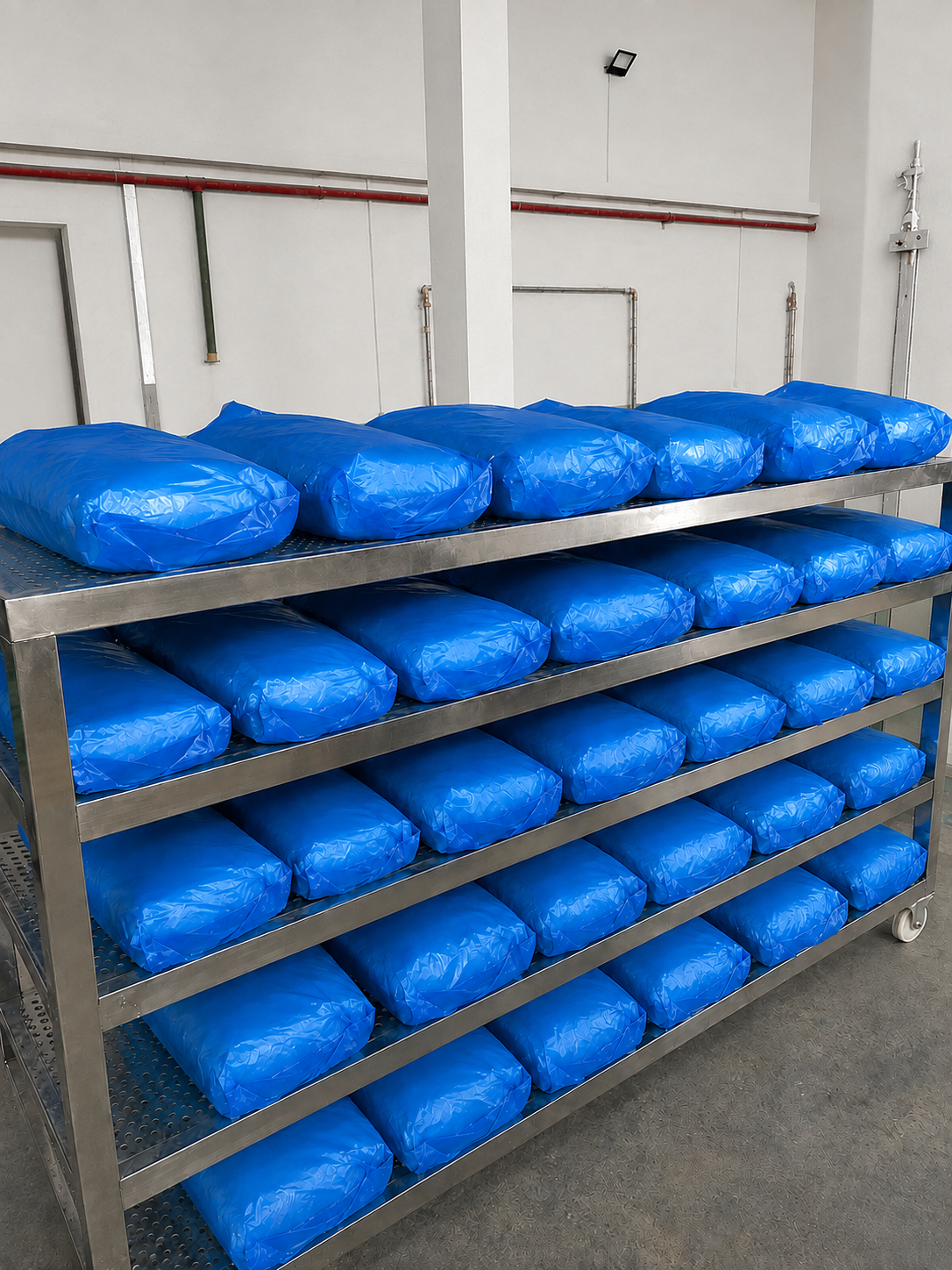
Storage and identification practice matters for base compound supplied without pigment or curing agent: uncontaminated, clearly labelled material protects the formulation.
Where Food-Contact HTV Silicone Rubber Is Used
The vetting checklist applies across the main food-contact applications for solid HTV compound:
- Kitchenware and baking molds. Food-grade HTV silicone rubber for kitchenware and baking molds is one of the core product families for food-contact grades, where heat resistance and clean demolding of thin sections are the critical requirements.
- Food-processing gaskets and seals. Silicone rubber for gaskets is used where repeated contact with food plus repeated cleaning cycles make heat resistance and compression behaviour decisive.
- Appliance and industrial components. Silicone rubber for automotive and industrial components frequently uses the same food-contact-capable compounding base, and the same documentation logic applies when a part must withstand elevated temperature and oils.
- Extruded food-contact profiles. Extrusion-grade HTV silicone rubber is available where a supplier must supply tubing or profile rather than molded parts, which changes the cure and throughput questions but not the documentation requirements.
One boundary is worth stating clearly. Solid HTV compound is the appropriate route for compression and injection molding of solid parts. Where a component requires liquid injection molding of very small or highly detailed geometry, liquid silicone rubber (LSR) is the more common choice — LSR held 48.1% of the silicone elastomers market in 2025, primarily for precision medical and automotive parts (Silicone Elastomers Market Report 2035). A vetting checklist should therefore begin with a process decision, not only a supplier decision.
FAQ
What documents prove that a food-contact HTV silicone rubber grade meets FDA 21 CFR 177.2600?
Third-party test documentation issued against FDA 21 CFR 177.2600 for the specific grade, supported by the grade TDS, SDS, Typical COA and batch COA. FDA 21 CFR 177.2600 addresses rubber articles intended for repeated use in contact with food, so the report should identify the compound reference and the test conditions rather than only the supplier's general capability. For EU destinations, request LFGB test reports and REACH compliance documentation as separate evidence, and confirm the supplier's quality system through a valid certificate such as ISO 9001.
Should a food-contact HTV silicone rubber base compound be supplied without pigment or curing agent?
In most cases, yes. A base compound supplied without pigment or curing agent leaves color, cure speed and additive declaration under the buyer's control, which makes the food-contact formulation easier to audit and easier to reproduce from batch to batch. If the supplier delivers pre-compounded material instead, request a written additive declaration covering pigment type and dosage, curing agent type and dosage, and any processing aids, then re-validate the processing window — for example a DBPMH dosage of about 1.5% and a molding cure of about 180 °C for 5 minutes — against your own equipment.
How can a buyer verify that an HTV silicone rubber supplier is a real manufacturer rather than a trader?
Look for manufacturing evidence instead of sales claims: a physical plant with compounding equipment, a stated monthly capacity, named quality-control steps, grade-specific documents (TDS, SDS, Typical COA, batch COA) and applicable third-party test reports. Yakows Technology (Dongguan) Co., Ltd. illustrates the type of evidence to request: a Dongguan-based compound manufacturer established in 2020 with a 5,000 m² facility, a quality-control laboratory, monthly capacity of 400,000–1,000,000 kg, ISO 9001 certification, and approximately 70% of output supplied to overseas customers. Documentation that is grade-specific and reproducible is a stronger signal than any single certificate image.
What MOQ, lead time and capacity should a food-contact HTV silicone rubber buyer expect?
Yakows Technology (Dongguan) Co., Ltd. quotes an MOQ of 2,000 kg, with trial quantities discussable for product qualification; standard grades at 3–7 working days and customized grades at 10–20 working days after sample approval; and monthly capacity of 400,000–1,000,000 kg depending on grade and production schedule. Treat these as reference points and confirm the terms for your specific grade, packaging and destination, because a customized formulation changes both minimum order quantity and lead time.
How should a buyer validate a food-contact HTV silicone rubber sample before mass production?
Request a sample of the exact grade and cure system you intend to run, mold it under your own press conditions — typically a DBPMH dosage of about 1.5% and a cure of about 180 °C for 5 minutes — and test hardness, tensile strength, elongation and tear strength against the agreed benchmark, for example 50 ± 3 Shore A, ≥ 7.0 MPa, ≥ 700% and ≥ 18 kN/m on a reference grade such as YKS-8850. Repeat the check on a second batch to confirm consistency, then compare the batch COA with your measured results before releasing the grade to production. As a next step, you can request a food-contact grade sample or quotation from Yakows Technology (Dongguan) Co., Ltd. at sales@yakows.com, or download the Yakows product brochure (PDF) to review the grade families first.
Conclusion: Documentation First, Purchase Order Second
Food-contact grade HTV silicone rubber is selected on evidence, not on a data-sheet headline. The three questions that carry the most weight in supplier vetting are whether third-party documentation exists for the exact grade against FDA 21 CFR 177.2600 (plus LFGB and REACH for EU markets), whether the base compound is supplied without pigment or curing agent so that the cure system stays under the buyer's control, and whether the stated processing window — around 1.5% DBPMH with a 180 °C, 5-minute molding cure — matches the buyer's press. Mechanical benchmarks such as 50 ± 3 Shore A, tensile strength ≥ 7.0 MPa, elongation ≥ 700% and tear strength ≥ 18 kN/m provide the reference point against which each batch COA can be compared.
None of these steps replaces finished-article testing, and a supplier that passes document review still has to pass a production trial with the buyer's own mold, cure conditions and downstream hygiene controls. What the checklist does is remove the most expensive kind of uncertainty — discovering a compliance or consistency problem after the tooling is cut and the first containers have shipped.
Supplier contact and next step
Yakows Technology (Dongguan) Co., Ltd.
Website: https://yaksil.com
Email: sales@yakows.com
Tel / WhatsApp: +86 13549310838
Address: Tongsha Industrial Park, Dongcheng District, Dongguan City, Guangdong Province, China
Product brochure: Download the Yakows brochure (PDF)
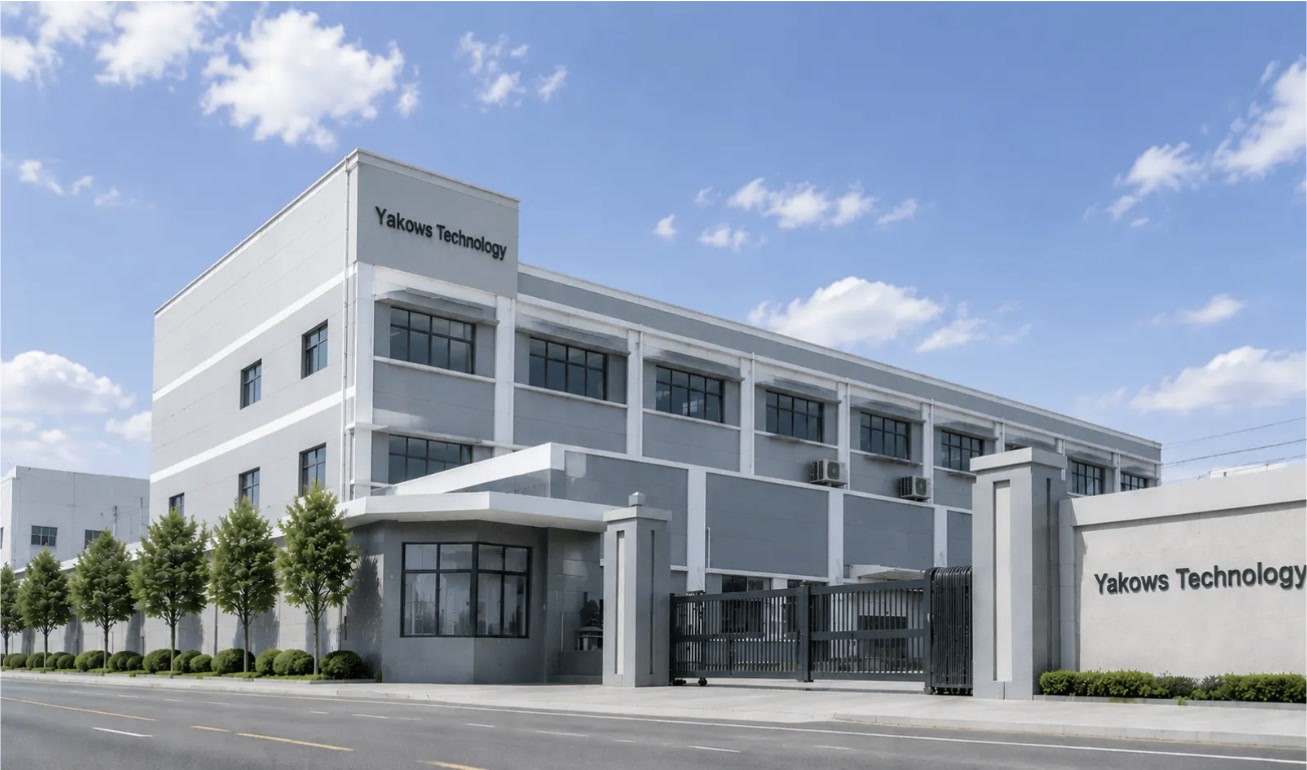
Sample requests for food-contact grade HTV silicone rubber start with a documented grade, a defined processing window and a batch-specific COA.
Have Questions or Need More Details?
Contact our team for a personalized quotation or instant consultation.
Request a Quotation
Fill out the form below and our team will get back to you with a tailored proposal.
WhatsApp Direct Chat
Prefer to chat in real-time? Message us on WhatsApp for instant assistance & quick answers.
- Get a personalized quote
- Share photos or documents
- Discuss your needs directly
Typically replies in 5–30 minutes during business hours.