
Custom OEM HTV Silicone Rubber for Composite Insulators: A Capability and Qualification Guide
OEM HTV Silicone Rubber for Composite Insulators: A Capability and Qualification Guide
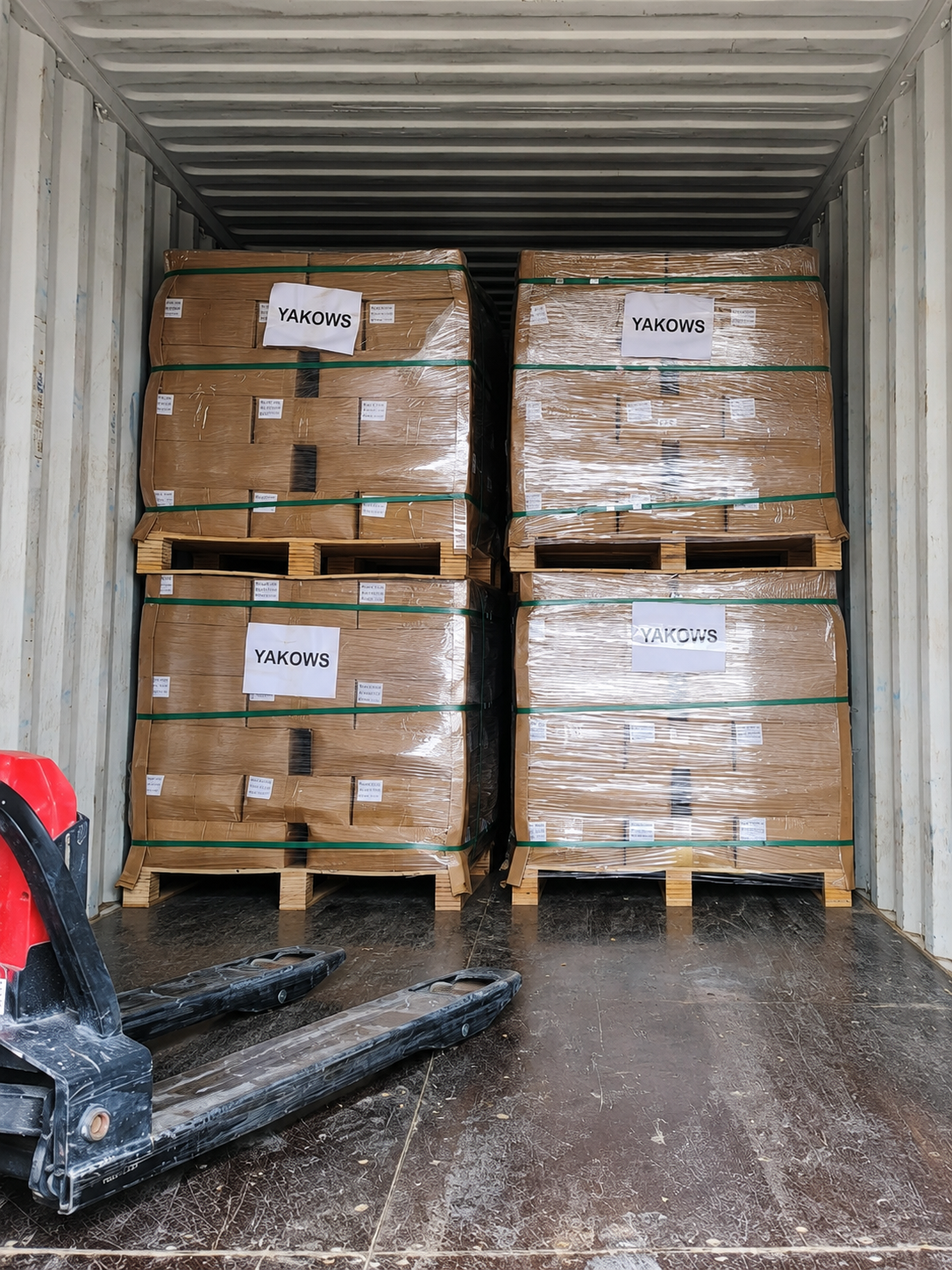
OEM custom HTV silicone rubber secured in export packaging for a composite insulator production line.
For manufacturers of composite insulators, the compound used for the outer housing and weather sheds is not simply one more polymer input. HTV silicone rubber for composite insulators must combine electrical insulation, water repellency, weathering resistance, flame retardancy, and mechanical strength in a material that can also be molded consistently on production equipment. During an evaluation-to-execution process, the real question is no longer only which material grade to buy; it is whether the silicone rubber supplier can deliver a customized, reproducible, and well-documented compound.
This guide explains what OEM and ODM capability means for HTV silicone rubber sourcing, how Yakows Technology (Dongguan) Co., Ltd. approaches custom formulation production, and which technical and commercial checks matter before a new grade moves into volume orders.
Why Insulator-Grade HTV Silicone Rubber Is Not a Commodity
HTV silicone rubber is a high-temperature-vulcanizing solid silicone compound, often called HCR or high-consistency rubber. It is supplied in solid form and cured under heat during injection or compression molding. In a composite insulator, this rubber is molded into the housing and sheds that protect the FRP core. The housing must perform under voltage, rain, salt fog, pollution, ultraviolet exposure, temperature cycling, and mechanical load for years of outdoor service.
An electrical insulation grade designed for composite insulators is normally formulated with reinforcing fillers and functional additives for outdoor insulation. It is tested for hydrophobicity, dielectric strength, volume resistivity, tracking and erosion resistance, UV aging, flame retardancy, and mechanical properties. A general-purpose compound selected only by hardness or price may be cheaper initially, but it can increase the risk of hydrophobicity loss, surface tracking, erosion, leakage current, flashover, UV aging, poor bonding to the FRP core, molding defects, and premature insulator failure. For this reason, insulator manufacturers should evaluate the formulation and the supplier capability together, rather than only comparing material names.
Industry Background: HTV Demand and Application Expectations
Third-party market estimates put the global silicone rubber market at about USD 5.7 billion in 2025, with HTV silicone rubber holding a dominant share of roughly 45.2%. Solid HTV silicone rubber is widely used for high-voltage insulation, automotive parts, industrial components, cable accessories, gaskets, and other molded products because its crosslink density and dielectric endurance are suited to demanding environments.
Within the insulator industry, material-grade documents and finished-product standards work together. IEC 61109 and IEC 62217 are commonly referenced for composite insulators, while IEC 60587 is used for evaluating tracking and erosion resistance of the polymeric housing. A silicone rubber supplier can provide material-level documentation and test reports, but compliance of the complete composite insulator can only be confirmed by the insulator manufacturer through production trials and finished-insulator validation.
Yakows Technology (Dongguan) Co., Ltd. is a China-based manufacturer of HTV/HCR silicone rubber compounds. Established in 2020, the company operates a 5,000 m² facility in Tongsha Industrial Park, Dongcheng District, Dongguan, with about 50 employees and a technical department that includes more than 10 engineers and technicians. Its production program covers HTV silicone rubber for composite insulators and electrical insulation, cable accessories, automotive and industrial components, food-grade kitchenware and baking molds, extrusion-grade compounds, fumed silica-reinforced HTV, flame-retardant and high-temperature-resistant grades, and customized HTV/HCR formulations.
The Real Problem in OEM Supplier Evaluation
Many buyers use the term OEM narrowly, as if it only meant private labeling a standard recipe. In practical supplier evaluation, OEM and ODM capability should be judged by how much of the compound can be changed and controlled. Yakows provides OEM, ODM, and custom formulation manufacturing services. The customization scope includes formulation, Shore A hardness, color, mechanical properties, electrical insulation properties, hydrophobicity, flame retardancy, curing system, packaging, and private labeling.
That scope has direct procurement consequences. A composite insulator producer may need a grade with a specific hardness range for thin sheds, a viscosity or flow profile suited to the mold, a cure system matched to the production temperature, a color code for utility approval, or a higher tracking resistance for heavily polluted environments. If the supplier can adjust the formulation and verify the resulting compound against electrical and mechanical targets, the buyer can move from an approximate product to a process-matched material.
Yakows Capability Profile at a Glance
- Production capacity: 400,000–1,000,000 kg per month, depending on product grade and production schedule.
- Standard lead time: 3–7 working days for standard grades.
- Customized lead time: 10–20 working days after sample approval for customized grades.
- Minimum order quantity: 2,000 kg per grade; trial quantities may be discussed for product qualification.
- Quality control: each production batch is inspected for appearance, Shore A hardness, density, tensile strength, elongation, tear strength, and applicable electrical properties; a batch COA can be provided before shipment.
- Export markets: Southeast Asia, the Middle East, Europe, North America, and Latin America.
- Quality system: ISO 9001 quality management system certification.
These facts matter for OEM buyers because capacity and lead time determine whether a qualified compound can be transferred into repeat production without changing the sourcing risk profile.
HTV Silicone Rubber for Composite Insulators: YK-3160 Grade Characteristics
One example of an application-specific electrical insulation grade is YK-3160, a high-performance electrical insulation grade from Yakows. It is formulated for molding the housings and weather sheds of high-voltage composite insulators, and its material parameters reflect the requirements of outdoor electrical service.
| Property | YK-3160 Typical Range | Why It Matters |
|---|---|---|
| Hardness | 65 ± 5 Shore A | Helps maintain shed rigidity and handling characteristics during molding. |
| Specific gravity | 1.46 ± 0.03 g/cm³ | Used for batch consistency and weight control. |
| Elongation | ≥220% | Indicates deformation capacity before break. |
| Tensile strength | ≥5.0 MPa | Supports handling, assembly, and installation stresses. |
| Tear strength | ≥12 kN/m | Reduces risk of damage at thin shed edges. |
| Hydrophobicity | HC2 | Supports water repellency and leakage-current suppression on outdoor surfaces. |
| Dielectric strength | ≥22 kV/mm | Supports high-voltage insulation performance. |
| Volume resistivity | ≥2 × 10¹⁴ Ω·cm | Indicates resistance to current flow through the material. |
| Dielectric constant | ≤5.0 | Relevant to capacitive behavior under voltage. |
| Dielectric loss tangent | ≤4.0 × 10⁻² | Relevant to dielectric losses under AC stress. |
| Flame-retardant rating | V-0 | Supports fire-safety requirements in outdoor equipment. |
| Tracking and erosion resistance | TM1A4.5, ≤2.5 mm | Helps resist surface tracking under pollution and electrical stress. |
| UV aging resistance | Pass | Supports long-term outdoor weathering performance. |
These values provide a reference for evaluating material documentation. The current TDS, batch COA, agreed specification, and applicable test reports should be reviewed before final approval.
General-Purpose HTV vs Insulator-Grade HTV Silicone Rubber
One of the most frequent questions in composite insulator sourcing is whether a general-purpose HTV silicone rubber can be used for outdoor housings. The short answer: a general-purpose compound may look acceptable in a simple hardness test, but it is not normally formulated or verified for long-term high-voltage outdoor insulation.
| Evaluation Factor | General-Purpose HTV Silicone Rubber | Insulator-Grade HTV Silicone Rubber such as YK-3160 |
|---|---|---|
| Primary design target | Conventional molded rubber parts | Outdoor electrical insulation components |
| Typical mechanical properties | Hardness, tensile, elongation, and basic processing | Hardness, tensile, elongation, and tear strength are controlled plus electrical properties |
| Dielectric performance | Not necessarily verified for insulator service | Dielectric strength ≥22 kV/mm, volume resistivity ≥2 × 10¹⁴ Ω·cm |
| Hydrophobicity and tracking resistance | Not specifically specified for outdoor insulation | HC2 hydrophobicity; tracking and erosion resistance TM1A4.5, ≤2.5 mm |
| Flame retardancy and weathering | May vary by generic grade | V-0 flame-retardant rating and UV-aging resistance pass |
| Recommended use | Ordinary molded parts without high-voltage insulation requirements | Composite insulator housings and sheds requiring reliable outdoor performance |
Even with an insulator-grade compound, final suitability still depends on the mold design, FRP core surface preparation, primer compatibility, curing conditions, and finished-insulator tests required by the applicable voltage class and standard.
How OEM Custom Formulation Is Qualified in Practice
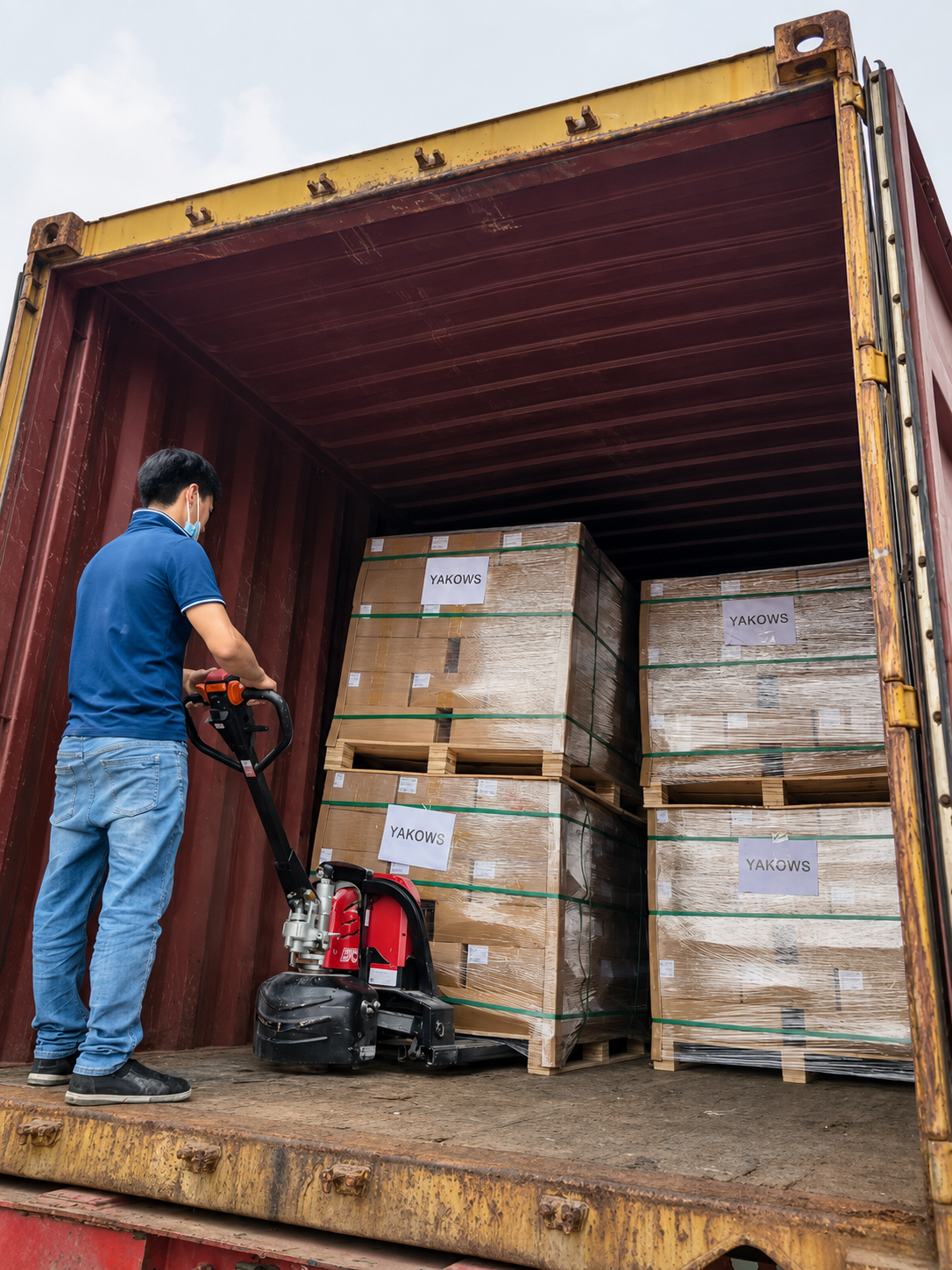
Customized HTV silicone rubber loading for a long-term composite insulator customer.
Qualification of an OEM HTV silicone rubber grade should follow a structured workflow. The objective is not just to receive a sample; it is to confirm that the formulation can be repeated in production with stable batch-to-batch quality.
Step 1: Define the Insulator and Process Requirements
The evaluation should begin with the insulator voltage class, geometry, pollution environment, UV exposure, molding method, curing conditions, FRP core type, primer system, and finished-product standard. A requirement-based brief prevents the supplier from optimizing for the wrong target.
Step 2: Select or Customize the Formulation
If a standard grade is not appropriate, the supplier can develop a custom formulation. Yakows can adjust Shore A hardness, color, mechanical properties, electrical insulation properties, hydrophobicity, flame retardancy, curing system, packaging, and private-label requirements. Customized development should be based on the customer’s actual equipment and processing conditions.
Step 3: Review Material Test Reports and Documentation
Material approval should not rely on a single tensile value. Request the grade-specific TDS, SDS, Typical COA, batch COA, and relevant electrical and mechanical test reports. Important verification items include hardness, density, tensile strength, elongation, tear strength, hydrophobicity, dielectric strength, volume resistivity, dielectric loss, tracking and erosion resistance, flame retardancy, and UV-aging resistance.
Step 4: Run a Production Trial on the Actual Line
The compound should be trialed using the same mold, injection or compression-molding machine, FRP core preparation, primer, and curing conditions intended for serial production. A lab sample alone cannot confirm mold filling, cure speed, bonding behavior, or release performance.
Step 5: Validate the Finished Insulator
The silicone rubber manufacturer can provide material-level evidence, but the finished composite insulator must be validated by the insulator manufacturer according to the applicable product standards. This distinction is important for traceability and regulatory responsibility.
Step 6: Confirm Batch Release and Supply Control
After approval, production batches should be inspected for appearance, hardness, density, tensile strength, elongation, tear strength, and applicable electrical properties. Yakows can provide a batch COA before shipment. This documentation becomes part of the buyer’s incoming material control and traceability system.
Execution Case: Customized HTV for a High-Voltage Composite Insulator Manufacturer
A working example of OEM capability is Yakows’s long-term cooperation with a high-voltage composite insulator manufacturer in Vietnam, running since November 2023. The customer molds HTV silicone rubber housings and sheds for composite insulators used in power transmission and distribution systems.
- Volume scale: up to 40,000 kg per month, approximately two 20GP containers.
- Application: molding silicone rubber housings and shed profiles for composite insulators.
- Formulation approach: a customized HTV silicone rubber formulation matched to the customer’s molding equipment, processing conditions, and finished-product requirements.
- Observed operational benefit: consistent batch-to-batch quality and scheduled deliveries helped the customer reduce material variability, maintain production continuity, and improve quality consistency of its insulators.
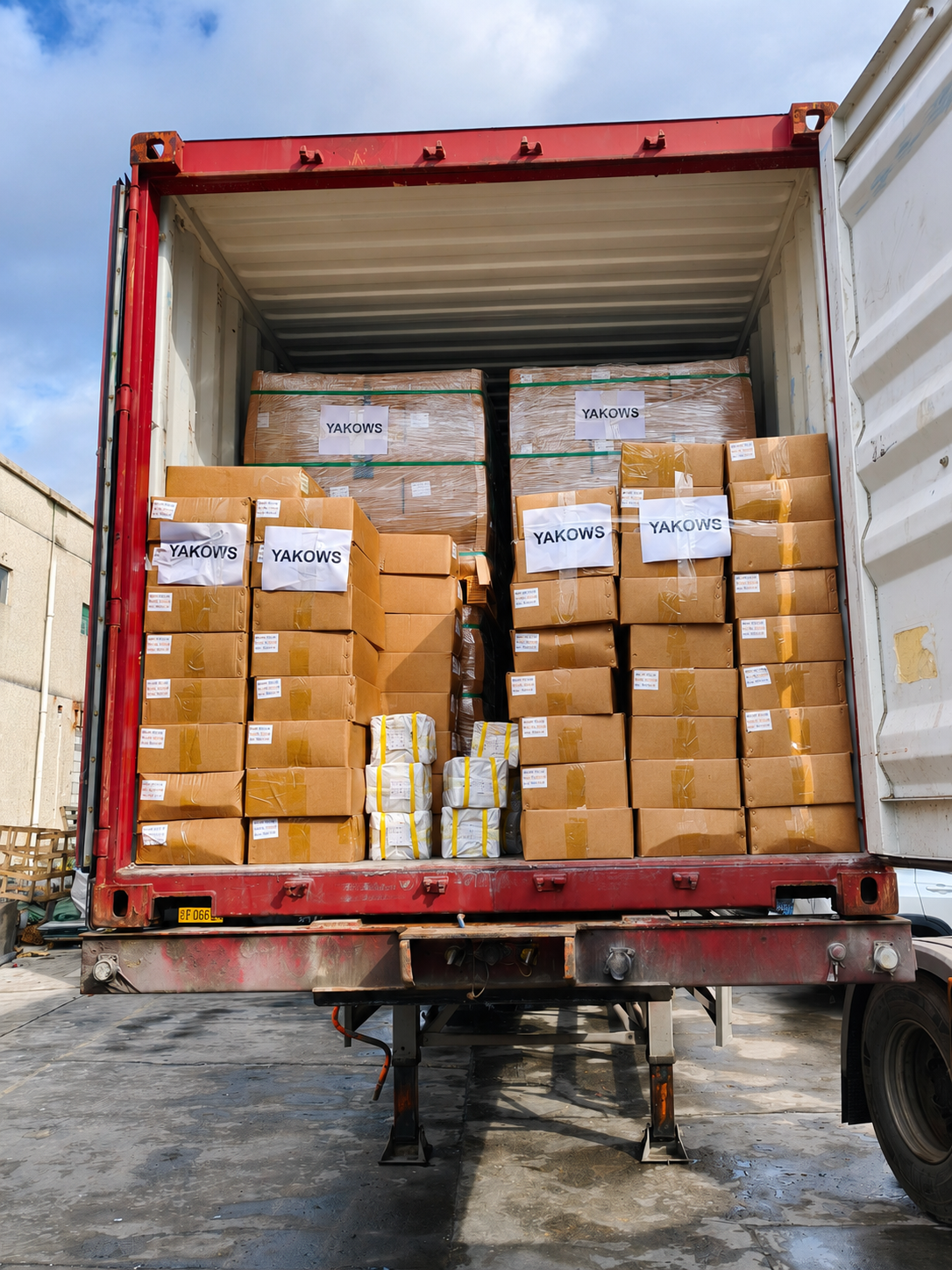
Completed container loading for a long-term customized HTV silicone rubber supply program.
This case shows that customized formulation is not a one-time lab exercise. It must be supported by production capacity, stable compounding, batch inspection, export packaging, and responsive technical support.
Commercial Execution Checklist for OEM HTV Silicone Rubber Orders
When the technical evaluation is complete, buyers still need to align commercial expectations before execution. Yakows provides the following typical terms:
- MOQ: 2,000 kg per grade or specification. Trial-order quantities are subject to confirmation.
- Delivery: FOB Shenzhen, China is available; EXW, CFR, or CIF terms can also be discussed according to destination and quantity.
- Inspection: pre-shipment inspection according to the mutually agreed specification; each batch is inspected before release and a batch COA can be provided. Third-party inspection may be arranged by prior agreement.
- Payment: 100% T/T before shipment for initial orders; alternative terms for repeat or large-volume orders are subject to mutual agreement and credit approval.
Lead time should also be part of the execution plan. Standard grades are typically ready in 3–7 working days, while customized grades normally take 10–20 working days after sample approval. For a project-driven composite insulator manufacturer, this distinction affects purchasing schedules and inventory planning.
Technical Documentation and Certification
Yakows operates a quality management system certified to ISO 9001. In addition, applicable grades can be supported by FDA food-contact compliance documentation, LFGB test reports, REACH compliance documentation, and other relevant certificates according to the intended application. Grade-specific documents including TDS, SDS, Typical COA, batch COA, and applicable third-party test reports can be provided.
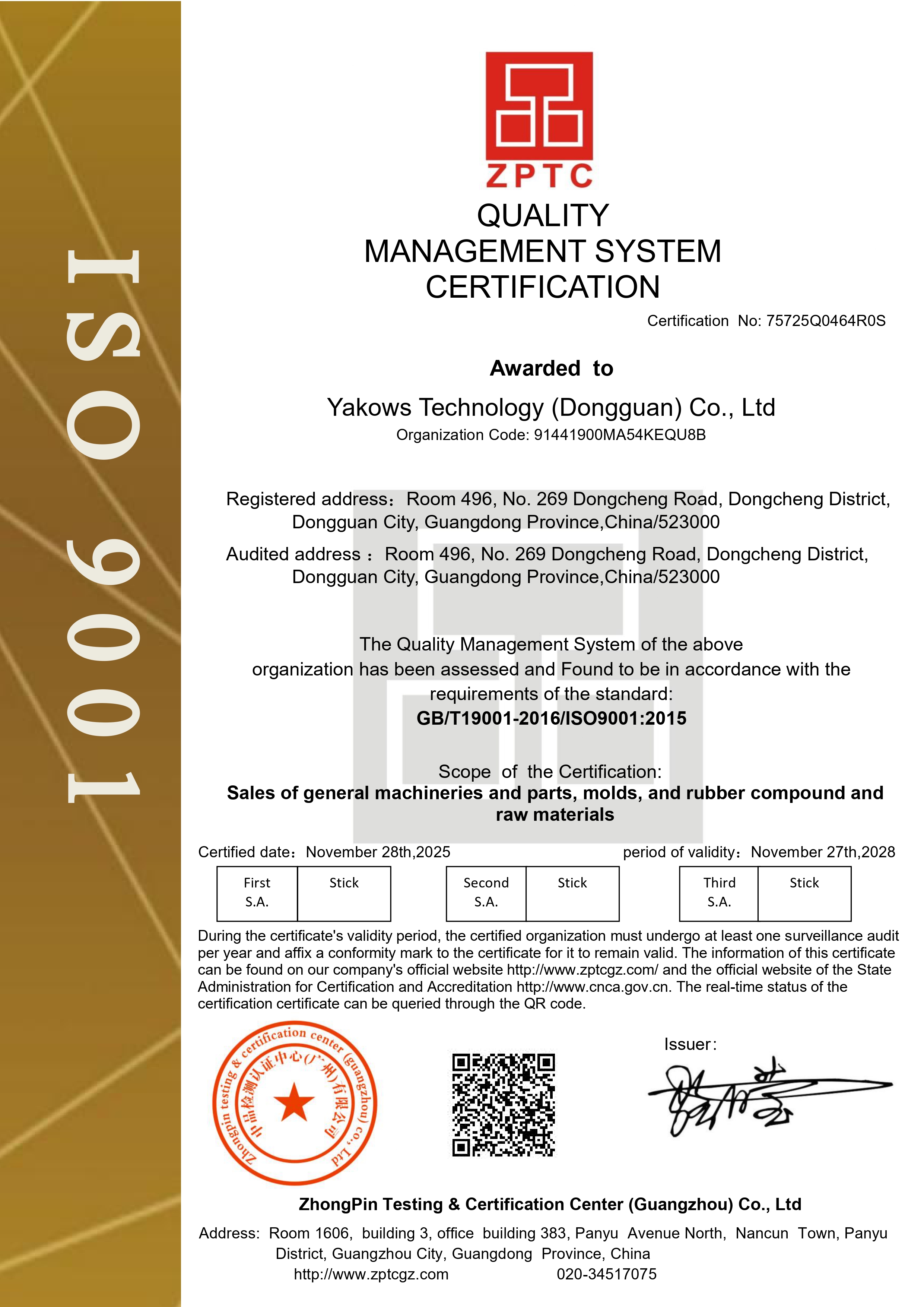
Yakows ISO 9001 quality management system certification.
Before ordering, buyers should verify the current documentation of the exact grade being considered. A historical certificate or generic data sheet is not enough for electrical insulation compounds used in high-voltage products.
Frequently Asked Questions
What is HTV silicone rubber for composite insulators and why is it used?
HTV silicone rubber for composite insulators is a solid high-temperature-vulcanizing compound formulated for molding the housing and weather sheds of composite insulators. It must protect the FRP core and provide electrical insulation, hydrophobicity, tracking and erosion resistance, UV weathering resistance, flame retardancy, and mechanical strength in outdoor service.
Do you offer OEM or ODM services for composite insulator silicone rubber in China?
Yes. Yakows Technology (Dongguan) Co., Ltd. provides OEM, ODM, and custom formulation manufacturing services. Customization can cover formulation, Shore A hardness, color, mechanical properties, electrical insulation properties, hydrophobicity, flame retardancy, curing system, packaging, and private labeling. The company also provides technical consultation, grade selection, trial-production guidance, processing troubleshooting, and batch traceability support.
Should I use general-purpose HTV silicone rubber or an insulator-grade compound such as YK-3160?
For outdoor composite insulator housings and sheds, an electrical insulator-grade HTV silicone rubber is recommended. YK-3160 is designed and tested for hydrophobicity, dielectric strength, volume resistivity, tracking and erosion resistance, flame retardancy, and UV aging. General-purpose HTV silicone rubber is more suitable for ordinary molded products that do not require verified high-voltage outdoor insulation performance.
Which technical documents and tests should be checked before approving a custom compound?
Request the current TDS, SDS, Typical COA, batch COA, and relevant electrical and mechanical test reports. The verification list should normally include hardness, density, tensile strength, elongation, tear strength, hydrophobicity, dielectric strength, volume resistivity, dielectric loss, tracking and erosion resistance, flame retardancy, and UV-aging resistance. Finished-insulator testing remains the responsibility of the insulator manufacturer.
What are the MOQ, lead time, and first step for OEM qualification?
The standard MOQ is 2,000 kg, while trial quantities may be discussed for product qualification. Standard grades can be produced in 3–7 working days, and customized grades usually take 10–20 working days after sample approval. To begin, contact Yakows with the insulator application, target voltage class, molding process, and required electrical or mechanical specification. A sample or trial production can then be arranged using the actual manufacturing conditions.
Need a customized HTV silicone rubber compound for composite insulator production? Contact Yakows Technology at sales@yakows.com or WhatsApp +86 13549310838 with your formulation and qualification requirements.
For a full product overview, download the Yakows company brochure.
Conclusion
Choosing an OEM HTV silicone rubber for composite insulators is not simply a search for the lowest-cost solid silicone material. It is an evaluation of formulation capability, reproducibility, testing discipline, and execution support. Yakows Technology offers application-specific compounds such as YK-3160, custom OEM/ODM development, ISO 9001 quality management, document support, and export-scale capacity for composite insulator manufacturers moving from evaluation into serial production. The most reliable path is to confirm the formulation, validate it on the actual molding line, and document every approved batch before formal production begins.
Have Questions or Need More Details?
Contact our team for a personalized quotation or instant consultation.
Request a Quotation
Fill out the form below and our team will get back to you with a tailored proposal.
WhatsApp Direct Chat
Prefer to chat in real-time? Message us on WhatsApp for instant assistance & quick answers.
- Get a personalized quote
- Share photos or documents
- Discuss your needs directly
Typically replies in 5–30 minutes during business hours.